
Evolutionary Systems Biology Home
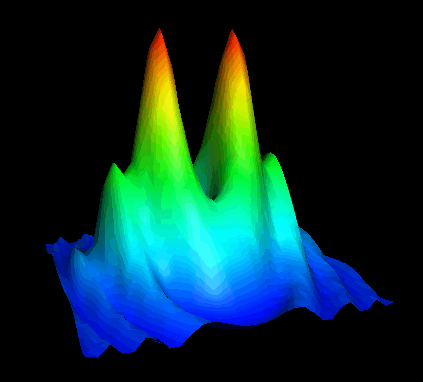
This picture symbolizes much of what we know about fitness landscapes: Fascinating, important, but mostly in the dark. We often don't know what axes to use, let alone how to navigate them. A key goal of EvoSysBio is to quantify various aspects of fitness landscapes to improve our understanding of this important metaphor.
|

Welcome! |
|
Evolutionary Systems Biology aims to bring together the rich mechanistic details of current systems biology and the long-standing quantitative experience of evolutionary genetics in order to increase the quantitative rigor of biological analyses. We have provided a short introduction on our website, for a more thorough introduction and definition of EvoSysBio, see this free chapter from the Encyclopedia of Evolutionary Biology (2016). Why is EvoSysBio so important? In a nutshell:
Thus EvoSysBio aims to properly quantify biologial systems in order to help understand more about the fitness landscapes that govern evolutionary dynamics. This is a huge task that will likely exceed what we can do in a generation. Thus current topics like reproducible data analysis and computation are of key interest for EvoSysBio as well. Trans-disciplinarity. EvoSysBio encompasses all of biology, because everything in biology belongs to a system, and systems in biology keep evolving, with enormous implications for understanding the past as well as the future. Thus, EvoSysBio is not some special subfield of biology; it rather aims to serve, inform, and inspire a broad variety of fields in biology. Definitions. Current systems biology has come to mean many things to many people, sometimes with confusing side-effects, in part because there was no initial formal definition to guide discussions. To reduce confusion, there was a determined effort to provide a comprehensive definition of mechanistic evolutionary systems biology. This effort built on a series of annual discussions that started in 2009 and culminated in the above mentioned definition published in 2016. Goals. By bringing together approaches from systems biology and evolutionary biology, EvoSysBio aims to help construct more realistic and illuminating models of life and its evolution. This goes beyond comparative analyses and aims to provide mechanistic models facilitate an in-depth understanding and are reliable enough to predict evolution. This is a notoriously difficult problem, as this is an occasion where chance and necessity meet. An analogous problem illustrates this. Weather forecasts are difficult because small chance events can combine with the necessities of physics, making predictions difficult. Still, computer simulation models have made tremendous progress in helping us to forecast both short-term weather and longer-term climate. EvoSysBio is working towards building corresponding simulation capabilities for key aspects of evolution. The question is, how far will we get in our lifetime? Such questions and related issues are discussed at annual Meetings on Evolutionary Systems Biology that so far have been organized in diverse contexts: Upcoming meetings that focus on EvoSysBio:
References Soyer O.S. (editor, 2012). Evolutionary Systems Biology. Book series: Advances in Experimental Medicine and Biology. Springer. Contents Ibarra, R. U., Edwards, J. S., & Palsson, B. O. (2002) Escherichia coli K-12 undergoes adaptive evolution to achieve in silico predicted optimal growth. Nature 420, 186-9. PubMed Wagner A (2008) "Neutralism and selectionism: a network-based reconciliation.", Nat Rev Genet 9:965-74. PubMed
|